









How Many Race Medals Should You Order? A Quantity Guide for 5K, 10K & Marathon Events

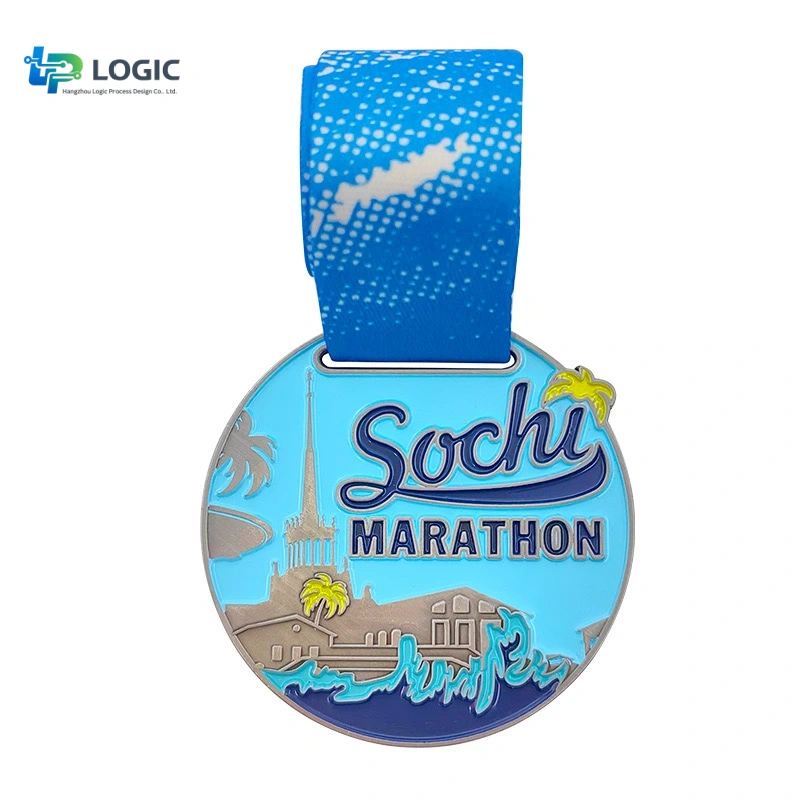
Ordering race medals is one of the few event decisions that has to be made before final registration numbers are fully known. Order too few and late registrations can create a finish-line shortage. Order too many and you may be left with dated medals that are difficult to reuse next year.
Quick answer: do not choose a medal quantity from one fixed percentage. Start with your expected eligible recipients, add known late-registration demand, count volunteers or special recipients separately, and keep a clearly defined operational reserve. For multi-distance events, calculate each medal version independently.
Why Race Medal Quantity Planning Matters More in 2026
Participation in organized running events continues to grow. RunSignup’s 2026 Midyear RaceTrends update reported average per-race participation growth of 5.9% in the first half of 2026, with larger races growing even faster. For race directors, that makes late-registration forecasting and medal quantity planning more important than relying only on last year’s final number.
If your event is growing, a simple “repeat last year’s quantity” approach can create shortages. If your event is new, guessing from registration capacity alone can create unnecessary inventory. A better method is to build the order from the event’s actual medal policy and registration forecast.
The Basic Race Medal Quantity Formula
A practical starting point is:
Medals to order = expected eligible recipients + late-entry allowance + additional recipients + operational reserve + replacement stock
Each part should be estimated separately instead of hiding all uncertainty inside one arbitrary buffer.
| Component | What It Covers | Planning Source |
|---|---|---|
| Eligible recipients | Finishers or registered participants who qualify for a medal | Your event medal policy |
| Late entries | Registrations expected after the medal order is placed | Historical registration curve or current pace |
| Additional recipients | Volunteers, pacers, sponsors, staff or invited guests | Confirmed event plan |
| Operational reserve | Unexpected race-day demand or distribution errors | Risk level chosen by organizer |
| Replacement stock | Damaged, missing or post-event replacement medals | Customer service policy |
Step 1: Decide Who Actually Receives a Medal
Before calculating quantity, define the medal rule. Different events use different policies:
- Every registered participant receives a medal
- Only official finishers receive a medal
- 5K and 10K participants receive different medals
- Fun run participants receive a separate design
- Virtual participants are included or excluded
- Volunteers, pacers or sponsors receive medals
If every registrant receives a medal, registration numbers matter more than finish rates. If only official finishers qualify, your own start and finish history becomes more useful.
This is also why a medal quantity calculation should match the event rules shown on your registration page.
Step 2: Use Your Registration Curve, Not Just Today’s Registration Count
Many races place medal orders before registration closes. If 600 runners are currently registered but the event historically receives 25% of registrations in the final few weeks, ordering only 600 medals would ignore a predictable part of demand.
For repeat events, compare:
- Registrations at the same number of days before race day last year
- Final registrations last year
- Year-over-year growth
- Any new marketing, sponsors or race-distance changes
- Current registration pace versus previous years
For a first-year event, use low, base and high scenarios rather than one number.
| Scenario | Purpose | Typical Assumption Style |
|---|---|---|
| Low | Tests excess-inventory risk | Conservative registration forecast |
| Base | Main planning case | Current pace + comparable event evidence |
| High | Tests shortage risk | Strong late registration and high attendance |
Step 3: Calculate Each Distance Separately
For a multi-distance event, do not combine all runners into one medal total if each distance uses a different design, ribbon or text.
A surplus of 5K medals cannot solve a half-marathon shortage.

A simple version map might look like this:
| Medal Version | Eligible Recipients | Additional Recipients | Reserve | Final Quantity |
|---|---|---|---|---|
| 5K | 420 | 10 | 15 | 445 |
| 10K | 260 | 5 | 15 | 280 |
| Half Marathon | 180 | 5 | 10 | 195 |
The figures above are examples only. Replace them with your own registration and event data.
How Many Extra Race Medals Should You Order?
There is no universal extra percentage that works for every race. The right reserve depends on how much uncertainty remains when you approve production.
A race with closed registration and stable participant numbers may need only a small operational reserve. A growing community 5K with race-day registration, sponsor allocations and a history of late sign-ups needs a different approach.
Instead of asking “Should we order 5% or 10% extra?”, ask:
- How many registrations are still realistically expected?
- Can people register on race day?
- Do volunteers or sponsors receive medals?
- Are there separate age-group or placement medals?
- Will replacement medals be mailed after the event?
- Can unused medals be reused next year?
That produces a more defensible quantity than one blanket percentage.
Worked Example: A Growing Community 5K
Suppose a community 5K expects 600 final registrations. Based on its own history, 90% of registrants typically start, and 98% of starters finish. The organizer also wants medals for 15 volunteers, 10 sponsors and a small replacement reserve.
An illustrative calculation could be:
- Expected starters: 600 × 0.90 = 540
- Expected finishers: 540 × 0.98 = 529.2, rounded to 530
- Volunteers: 15
- Sponsors: 10
- Operational reserve: 15
- Replacement stock: 10
- Illustrative final order: 580 medals
This is not a recommended percentage. It simply shows how to build the total from transparent assumptions.
Finisher Medals and Age-Group Awards Are Different Quantities
Race directors often combine two different medal programs:
- Finisher medals — based on participation or completion
- Placement / age-group medals — based on award categories
Placement quantities should be calculated from the published award structure, not from the registration forecast.
For example:
Placement medals = age categories × places per category × divisions
If there are 12 age groups, three places, and male/female divisions, the organizer needs 72 placement awards before adding any overall or masters categories.
Can One Medal Design Cover Several Distances?
Yes. If the goal is to reduce tooling complexity or simplify race-day distribution, one shared medal can be used across several distances, with differences handled through:
- Printed ribbon text
- Different enamel colors
- Back-side engraving
- Separate inserts
- Packaging labels
However, if the 5K, 10K and half marathon are intended to feel like different achievements, separate designs may create stronger perceived value.
For design planning, see our Race Medal Design Checklist.
Annual Races: Reduce the Risk of Leftover Medals
Dated medals are harder to reuse. Annual race organizers can reduce inventory risk by designing some information to change without rebuilding the whole concept.
Options include:
- Keep the core medal shape and change only the year
- Put the date on the ribbon instead of the medal body
- Use one long-term event logo with annual color changes
- Keep sponsor details on the back or ribbon
- Use a series concept that encourages repeat participation
This is especially useful for community 5Ks, school races, charity runs and annual corporate events where repeat orders are likely.
Quantity Also Affects Cost
Custom medal pricing is affected by quantity because mold, setup, finishing and production labor are spread across the order. But ordering more only to reach a lower unit price is not always economical if the extra medals will never be used.
Compare the total delivered cost, not only the unit price.
For a broader breakdown of pricing factors, see our Custom Medal Cost Guide.
Do Not Wait Too Long to Confirm Quantity
Race directors often want to wait until registration closes before confirming the medal order. That can create unnecessary production and shipping pressure.
A better workflow is to set a medal quantity freeze date based on your production schedule, then use registration forecasting to estimate the remaining demand.
See How Long Do Custom Medals Take to Produce? when planning the order deadline.
Race Medal Quantity Checklist
Before approving production, confirm:
- Who qualifies for each medal version
- Current registrations
- Expected late registrations
- Expected starters and finishers, if relevant
- Volunteer, sponsor and staff allocations
- Age-group and placement awards
- Operational reserve
- Replacement stock
- Whether unused medals can be reused
- Final event date and required delivery date
- Quantity for every ribbon or medal variation
FAQ
Should I order one medal for every registered runner?
Only if that matches your event policy. Some races give medals to every registrant, while others limit medals to official finishers. Build the order from your published rule.
How many extra medals should a 5K order?
There is no universal percentage. Estimate late registrations, additional recipients, operational risk and replacements separately, then add them to the expected eligible recipients.
Should volunteers receive race medals?
That is an organizer decision. If volunteers, pacers, sponsors or staff will receive medals, count them separately rather than hiding them inside the general reserve.
What if my registration is still open when I need to order medals?
Use your current registration pace, historical late-registration pattern and a low/base/high forecast. Set a quantity freeze date that still leaves enough production and shipping time.
Can leftover medals be reused next year?
Possibly, if the medal does not include a fixed year or date. Annual events can reduce leftover risk by putting changing information on the ribbon, back side or removable elements.
Planning Medal Quantities for a 5K, 10K or Marathon?
Send us your event type, estimated participant count, medal versions, deadline and destination. We can help review the specification before production and prepare a quotation for custom zinc alloy race medals. MOQ starts from 50 pieces.