








How Much Do Custom Challenge Coins Cost? A Complete Pricing Guide

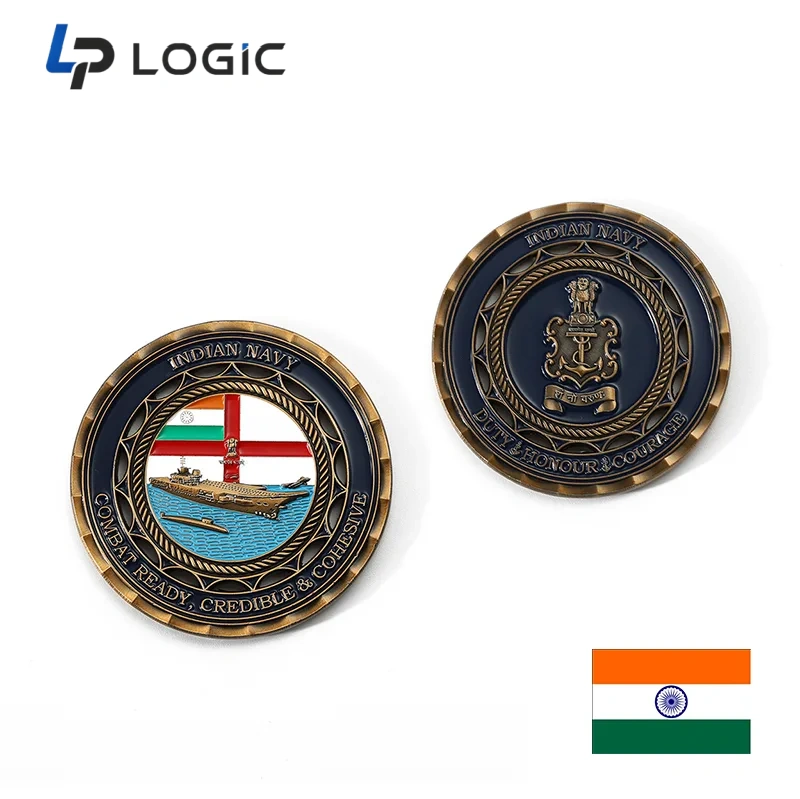
Custom challenge coin cost is not determined by diameter alone. Two coins with the same size can have very different prices depending on thickness, relief depth, plating, enamel colors, edge details, quantity, packaging and whether a new mold is required.
Quick Answer
The most accurate way to price a custom challenge coin is to quote the complete specification rather than use a fixed per-piece number. The biggest cost drivers are coin size and thickness, order quantity, 2D/3D complexity, plating, enamel coverage, custom edge work, mold/tooling and packaging. At Metallogic, custom challenge coin orders start from 50 pieces.
If you are still deciding dimensions, read our challenge coin size and thickness guide first. You can also browse our custom challenge coins to compare different finishes and relief styles.
What Makes Up the Cost of a Custom Challenge Coin?
A typical quotation can be understood as four parts: tooling or mold cost, unit production cost, optional packaging or accessories, and shipping. The balance between these changes from project to project.
Mold & Tooling
A new custom design normally requires tooling before production. Repeat orders using the same mold can reduce setup cost. See our guide to custom mold fees.
Unit Production
The per-piece cost reflects metal volume, casting, polishing, plating, coloring, relief complexity and finishing work.
Packaging
Standard bags are different from capsules, velvet boxes or presentation cases. Premium packaging should be quoted separately when required.
Shipping
Freight depends on finished weight, destination, service level and delivery deadline. Heavy coins can materially increase shipping cost on larger orders.
1. Coin Size and Thickness
Larger and thicker coins use more metal, which directly affects production cost and shipping weight. A compact 1.5-inch coin with simple relief will normally be more economical than a 2.25-inch coin with a thick body and deep sculpting.
For many projects, 1.75–2 inches and around 3 mm thickness are practical starting specifications. Move larger or thicker only when the artwork or presentation requires it.
2. Order Quantity
Quantity is one of the strongest influences on unit price. Mold setup, artwork preparation and production handling are spread across the order, so the cost per piece usually improves as quantity increases.
This is why comparing only the unit price at 50 pieces with the unit price at several hundred pieces can be misleading. Always compare quotations at the same quantity and specification.
3. 2D vs 3D Relief
Simple 2D relief uses clearly separated raised and recessed levels. It is efficient for logos, text, borders and many military-style emblems. Full or partial 3D relief requires more sculpting detail and deeper surface transitions, especially for portraits, animals, buildings and complex insignia.
A good cost-control approach is to use 3D only where it improves the design rather than making the entire coin heavily sculpted.
4. Plating and Finish
Gold, silver, copper and antique finishes create very different visual results. Specialty combinations, dual plating or additional finishing steps can increase production complexity.
If you are comparing finish options, read our challenge coin plating guide.
5. Enamel Colors
Color does not affect cost only by the number of Pantone shades. What matters is also how many separate recessed areas need filling, how small those areas are, whether color appears on one or both sides, and how much manual finishing is required.
A coin with four large enamel areas can be easier to produce than a coin with four colors divided into many tiny sections.
6. Custom Edges and Special Structures
Standard edges are generally more economical. Rope edges, gear-style edges, diamond-cut effects and other custom edge treatments add manufacturing steps. Moving or multi-part structures such as spinning centers also require more components and assembly.
For example, a custom spinning challenge coin should not be compared directly with a basic one-piece coin of the same diameter.
7. Single-Sided vs Double-Sided Detail
Most professional challenge coins use both sides, but production difficulty depends on the artwork. A simple reverse with text and a logo is different from a second side containing deep 3D relief, multiple enamel areas and detailed borders.
When requesting a quotation, provide artwork for both sides so the supplier can evaluate the complete project instead of pricing only the front design.
How to Lower Challenge Coin Cost Without Making the Product Look Cheap
Keep the Size Purposeful
Do not increase diameter unless the artwork needs the extra space. Better composition is often more effective than simply making the coin larger.
Use Selective 3D
Reserve deep relief for the main emblem or portrait and keep secondary text and borders simpler.
Simplify Tiny Color Areas
Combining very small enamel sections can improve manufacturability and reduce manual work without changing the overall concept.
Plan Repeat Orders
Reusing an existing approved mold can reduce setup work on future runs when the design remains unchanged.
What Information Is Needed for an Accurate Quote?
For a useful challenge coin quotation, send the following information together: quantity, diameter, thickness, front and back artwork, preferred plating, enamel requirements, edge style, packaging, shipping country and required delivery date.
If some specifications are undecided, send the logo or concept first. We can recommend a practical size and production structure based on the artwork.
FAQ
Is a larger challenge coin always more expensive?
Usually it uses more material, but total cost also depends on quantity, thickness, relief, finishing and packaging. Size should not be evaluated alone.
Does 3D relief cost more than 2D?
It can, especially when sculpting is deep or covers a large area. Partial 3D relief is often a useful compromise between visual depth and production efficiency.
Why does quantity change the unit price?
Setup and tooling work are distributed across more pieces, while larger production runs can use manufacturing time more efficiently.
Can I reorder the same coin later?
Yes. If the original mold and artwork remain usable and unchanged, a repeat order can avoid some of the setup required for a completely new design.
What is the MOQ for custom challenge coins?
Our MOQ starts from 50 pieces.
Request a Custom Challenge Coin Quote
Send us your artwork, quantity, target size, plating preference and delivery country. We will review the design and recommend a production specification before quoting.